

Learning the right lessons from the age of Trump
Welcome to The New Dynamic, a project of Equis.


“For every Presidential election really is a self-portrait of America.”
- Samuel Lubell, The Future of American Politics (1952)1
This is not the project we envisioned when we set out to explain what happened in the 2024 election. It was the second presidential election in a row where Latinos had shifted toward Donald Trump. The two of us – lead researchers at Equis – had authored lengthy post-mortems on Hispanic voters after the 2020 cycle and the 2022 midterms.
This time was different. The more we dug into the explanations, the more questions we unearthed, and the more it became apparent that many of the old ways of thinking about Latinos, including some of our own, were insufficient for the job.
Where before we had been trying to explain an election, we now needed to make sense of an era.
Welcome to The New Dynamic, a project to capture the right lessons from the age of Trump, in order to prepare for what follows. Over the months to come, we’ll share our account of movement among Hispanic voters in the Trump Era, and the color and dynamism it reveals behind a gridlocked American electorate. We can’t predict what will happen next. But we can think more clearly about it, and in the process try to lay the groundwork for a new working theory of Latino voters – because one is needed.
In The New Dynamic, you can expect a series of articles on what we’ve learned in trying to wrap our arms around the last decade, what we are still grappling with, and how it connects to current events.
This won’t be a comprehensive study of Latino voters today or of every element in the last few elections. We are focused on what has changed and what might still change. And while we might touch on some outreach best practices, we are also not focused on tactics (specific messages, targeting approaches or voter contact methods). Our colleagues at Equis will continue to disseminate tactical recommendations and of-the-moment guidance on Latinos in the current political and governing environment.
In this space we are taking a step back to ask: how should we think differently about Latino voters?
Prophecies and Perspective
A prognosticator writing in early 2017 couldn’t have foretold that the next few elections would bring Latinos to the brink of a GOP majority and back again. The frameworks of the time were ill-suited to the task.
This is not a new phenomenon. Analysts in every political era are prone to taking their own perspective and projecting it into the future, only to be caught by surprise when the ground shifts under their feet. “There is only a slim chance that the Democratic Party will become a party that represents the majority of Latinos in the United States,” wrote a pair of academics, “...in 1992.”2 Yet Bill Clinton would easily win the Latino vote that year and a majority of Latinos continued to identify as Democrats for some time thereafter.
Crystal balls cast in one era show their flaws when peering into the next.
Arguably, we as an ecosystem are still ill-equipped today. Old operating theories of Latino voters did not hold up in the Trump years. Now, in the vacuum that followed, a reliance on noisy bits of data and over-simplified narratives causes whiplash (“Democrats lost Latinos forever!”, “Latinos are back!”, ad infinitum). New confident predictions about the future are being made in 2026 based on political tea leaves – analyses of plurality-Latino precincts in low-salience special elections and noisy public crosstabs studied in a vacuum.
Democrats are on track to rebound with Latinos in 2026 thanks to the debacle of Trump’s second term. Trump’s awful ratings on his handling of the economy. Immigration overreach that broadly targets Hispanics and Latinos. The total abandonment of “America First.”
Hispanics’ social circles have turned against Trump. There is surging Democratic support among the swingiest Latinos – the low-propensity voters.
Prevailing winds of Trump’s second term, in 4 charts
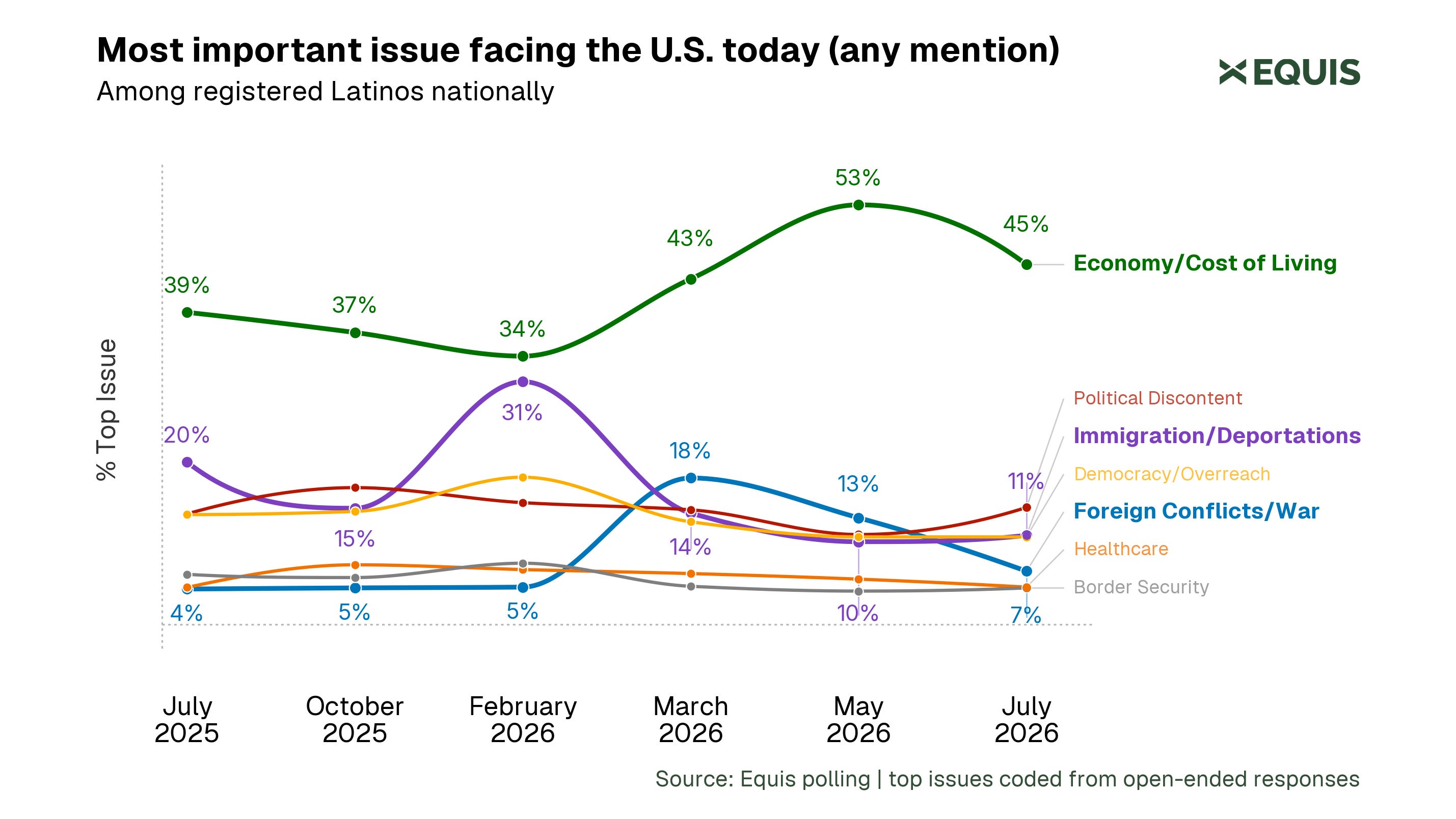
1. Voters’ top issue over time tells a story: Immigration was salient among Hispanics in spring/summer 2025 with the Kilmar Abrego García case and other stories of immigration overreach. Then the issue spiked again after the ICE/CBP killings in Minnesota. And it dropped in salience when Trump’s war on Iran replaced it. The economy and cost of living, high throughout, rose again in prominence with the war and the ensuing hike in gas prices.
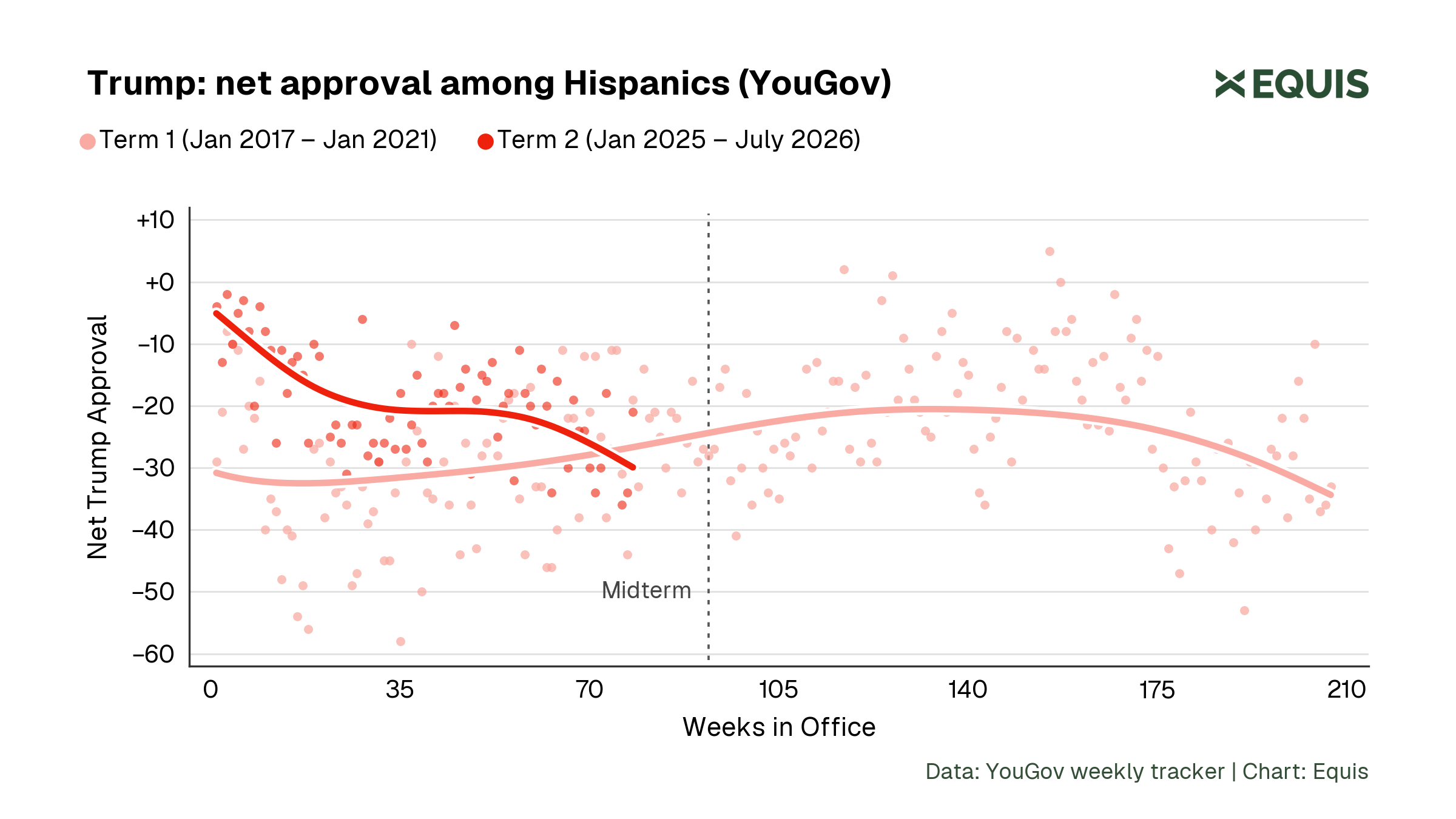
2. Trump started his second term at high (for him) approvals among Hispanics. His honeymoon among Latinos ended in spring and summer 2025, after the tariff roll-outs on Liberation Day and the rise in immigration actions. He then plateaued (both in Equis polling and the YouGov weekly tracker), and even remained above where he’d been at the same point in his first term. That changed in spring 2026 after the start of the war: presidential approval is currently trending below 2018, which has implications for the incumbent’s party in a midterm.
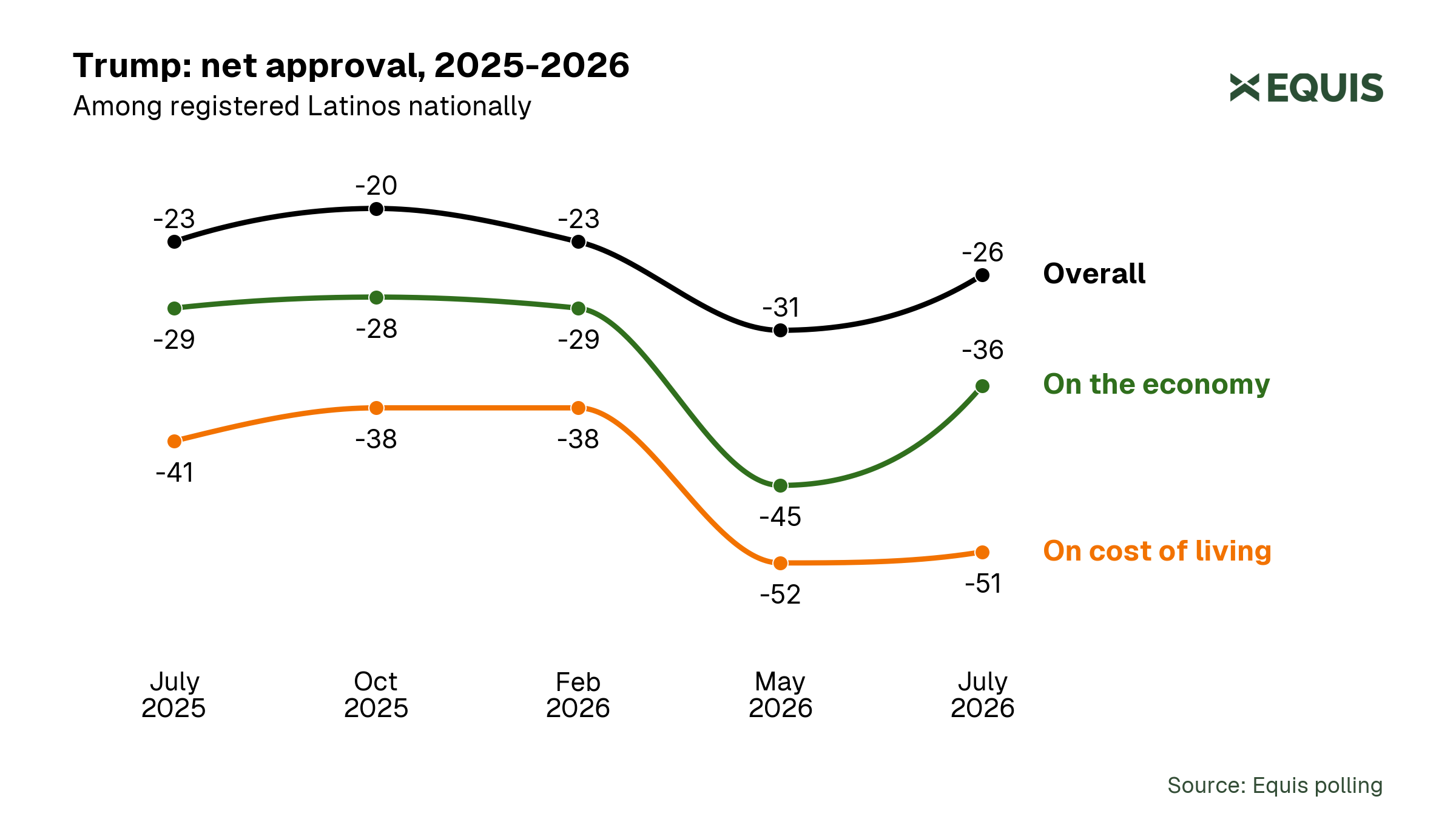
3. Voters’ top issues – the economy and costs – helped Trump among Hispanics in the 2024 election. Now they are liabilities for him. Cost of living, in particular, has been Trump’s worst-rated issue area throughout the cycle. During his first term, he was typically rated better on his handling of the economy than on his overall job performance. In his second term, we see the flip: a hidden strength has turned into an underlying weakness.
4. Trump’s early troubles took a toll on his party: Latinos’ views of the GOP took a hit in the summer of 2025 and haven’t revived. That has undoubtedly helped the Democrats rebound ahead of the midterms. But views of the Democratic Party are divided and have shown no improvement, a sign of an incomplete recovery from the damage of the Biden years.
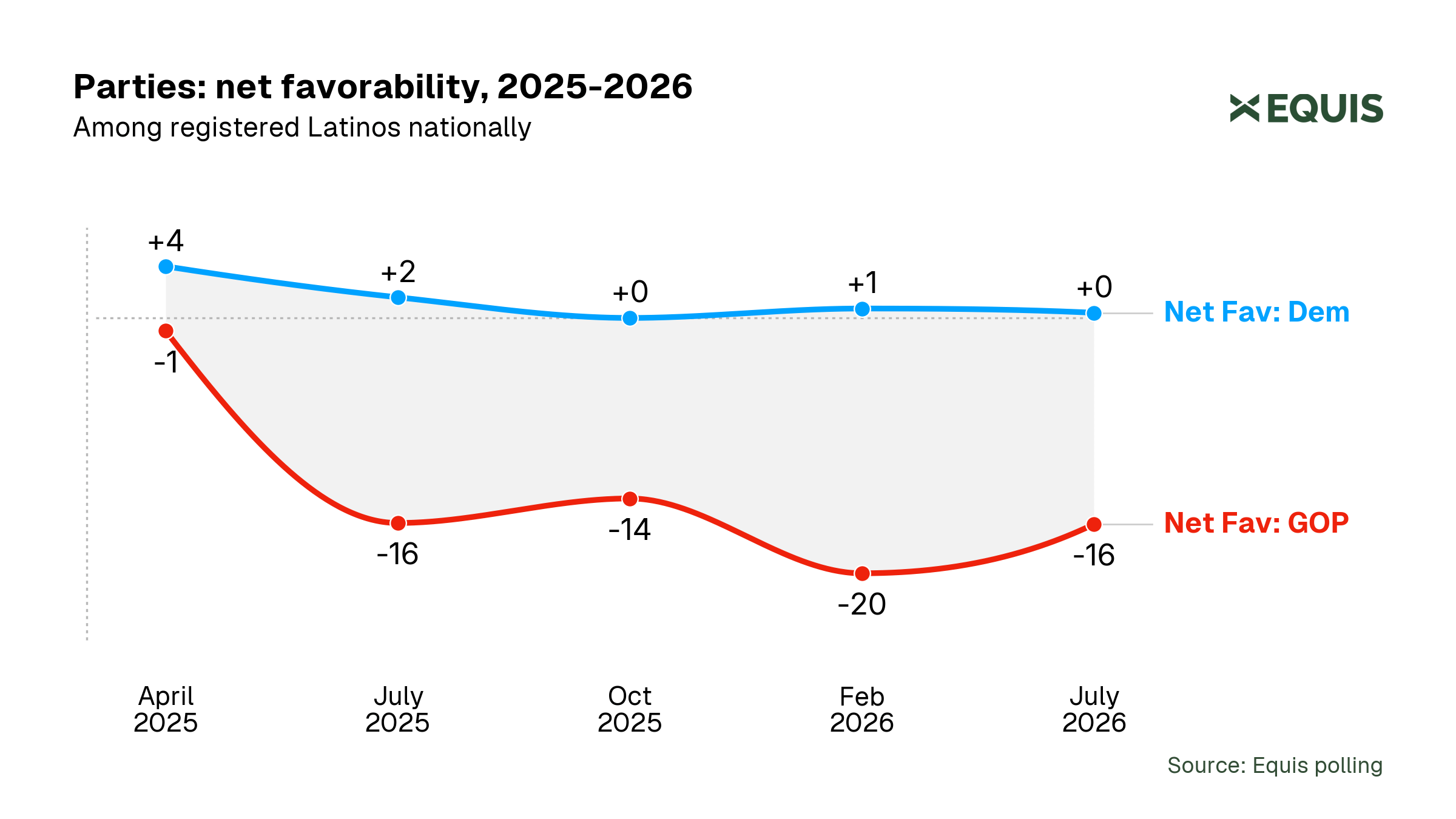
It would certainly appear that Republicans had a historic opportunity to remake the electorate and they blew it.
But to stop our analysis there is to miss out on the deeper lesson.
Understanding how short-term swings from election-to-election sit alongside longer-term social forces, as we’ll endeavor to do in this series, allows us to see past the vicissitudes of the moment.
In fact, as we’ll explain, it is premature to say we’ve returned to Democratic dominance in the way it looked in earlier, pre-Trump eras. The historic alliance of Hispanic voters and the Democratic Party still stands, but it is rickety from repeated blows. The long-term trend in party identification among Latinos reveals not a full-blown realignment toward Republicans but perhaps its infancy: a prolonged dealignment away from Democrats and toward identifying as Independents.3 And even now, after the wreck of Trump’s second term, Republicans will still hold on to some portion of their Trump-era gains among Latinos, and future GOP success is still possible. Both parties have choices they can make to alter their fates – if they first understand what is happening.
We are at the precipice of yet another political age. We can’t predict what will come in the next 10 years. But we can be better prepared to navigate it.
A Preview of Things to Come
Preparing for the future requires three hard things: updating old, one-dimensional ways of thinking about Latinos; revisiting the big foundational questions; and wrestling with what it all adds up to. Here is a preview of what’s to come on each front.
1. Updating From Monochrome to Technicolor
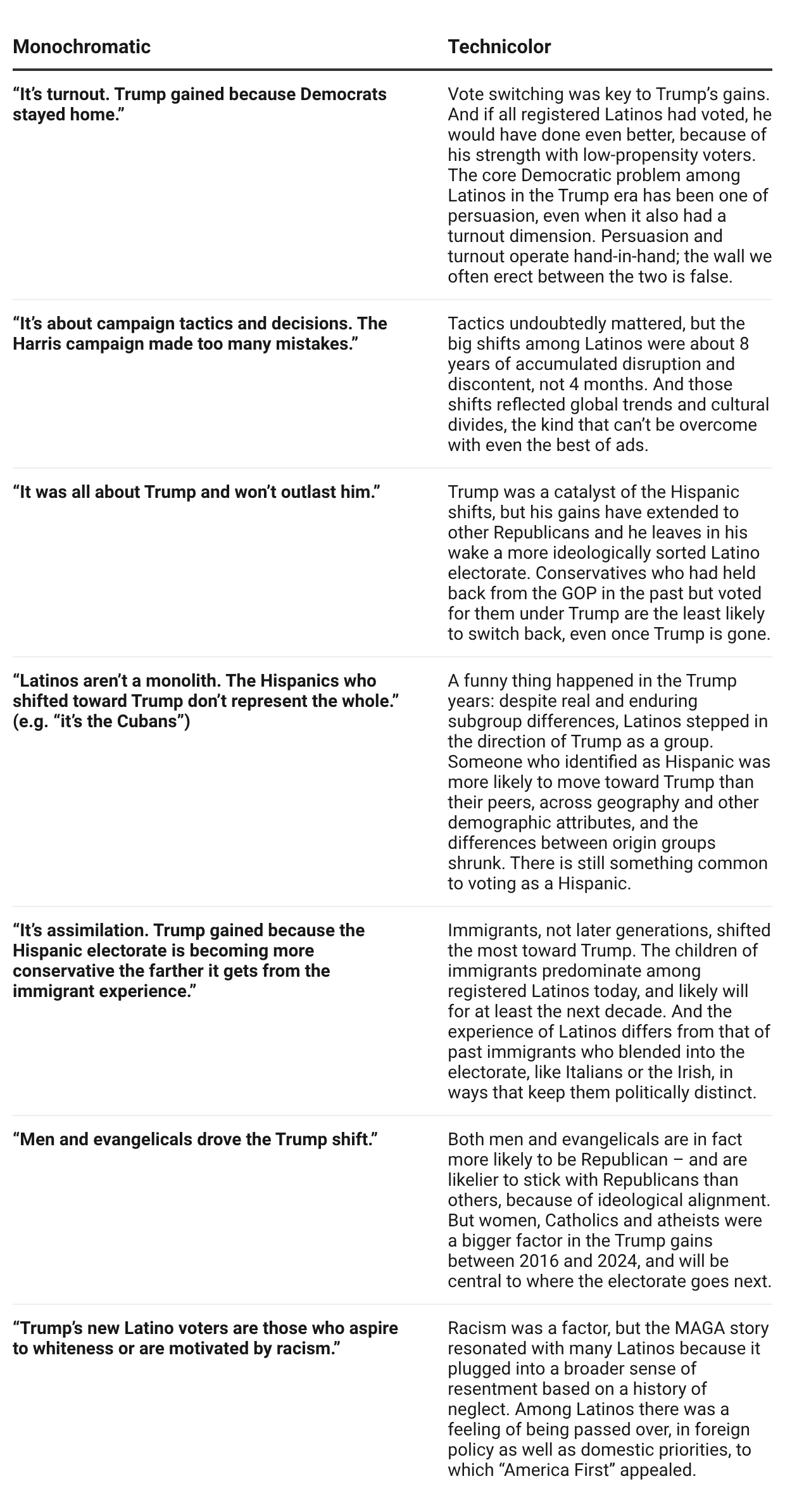
One step in the journey is to recover the critical information that is lost when we settle for easy explanations of Trump’s Latino gains. As we grappled with the nature of the shift ourselves, we found many ways in which opaque, outdated thinking – black-and-white assumptions, absolutism, and over-simplification – have flattened and desaturated Latino voters.
The goal now is to see with clear eyes what has been revealed in the age of Trump. The Latino shifts expose an expansive lattice of beliefs and identities, if we give them right, honest attention. A monochromatic view opens into something multi-faceted; out of the Trump era steps a technicolor voter.
In this series we’ll tackle some of the common explanations of Trump’s gains, and show what a fuller interpretation offers us.
2. Revisiting the Foundations
At the same time that we’re updating monochromatic views, we’ll be revisiting some of the foundational topics of the Latino vote. Ideas from across disciplines can help us understand identity, issue preferences and partisanship in the light of what we’ve learned in the Trump elections.
Among the lessons we hope to tease out:
Seeing the economy, and voters’ self-interest, as more than just material.
Reconceptualizing immigration as a two-pronged issue, where different fights invoke different identities and values.
Understanding being Latino as a “lunch table identity,” one among multiple identities that conspire and compete.
Locating the roots of Latino partisanship in the New Deal, before there even was a “Latino vote.”
Elevating voters’ social circles as central to what happened in the Trump elections, and to the reaction today.
3. Toward a Framework
To what do these new lessons add up?
The picture we think you’ll see is of voters, as a group, in a constant both/and. Both close to the immigrant experience and fully American. Both within the Black-White binary and outside of it. Both Hispanic and containing multitudes. A group balancing long-standing political allegiances and new ideological pressures, and oscillating between order and turbulence.
This federation of multi-hyphenated Americans has a traditional political home in the Democratic Party. But where they perceive they belong, truly, isn’t permanently resolved, and the answer is less obvious now than it has been at other points in the past.
What that means in practice is that the Latino vote is neither fully base nor fully swing. The default party remains the Democrats for most. But around a third of the group is truly persuadable.
Even how they think of themselves, and the parties, is subject to revision as both short-term and long-term forces move and interact. This project is ultimately an effort to inventory these forces: Why most Hispanics will still default to the Democratic party. Why that traditional allegiance is threatened, by societal changes that act as a slow right-ward erosion. How cycle to cycle the persuadable segment of Latino voters can still fluctuate, often widely, in changing contexts that determine the direction and degree of movement. How the high level of churn among Latinos – voters cycling in and out of the electorate – is itself a unique feature of Latino voting, a source of its unending dynamism. And how this framework sheds new light on the 2024 election, and on election results to come.
What are the implications for political actors?
Complexity does not have to be complicated. In some respects our way of thinking is simple for campaigns who want to take advantage of the incredible potential swing among Latinos: They should aim to persuade. Get back to basics on voter registration. Talk to voters about the issues that matter most to them — which are, with the rare exception, the same for most voters. There is rarely a need to create separate issue channels for Latinos; campaigns can say the same things to everyone. Latinos are not extraterrestrials, after all. What is needed – critically – are changes in messengers, language and imagery relevant to the voters they are trying to reach.4
In other ways our analysis presents a steeper challenge. Overcoming large structural divides and cultural trends takes more than an ad. As a 31-year old Mexican-American man in Arizona told us recently of Democrats, “the party has an air of hero complex, ‘we’re better, we’re here to help’ rather than I am you.”
Getting to “I am you” is the central challenge before the parties, and difficult because it is hard to fake. Superficial appeals that lack conviction or a willingness to upset powerful people are easy to dismiss. But getting it right is a burden that cannot be shirked by those who want to get our democracy out of its current predicament.
The stakes of this undertaking start with the 2026 midterms. The competitive House map in 2026 is uniquely Latino, relative to the rest of the population. Where Latinos land is likely to determine what kind of margin Democrats enjoy in the House after this year, and could also decide a Senate seat.
But the stakes don’t end there. There is a broader agenda here too. A paradox of American politics today is that in some ways the electorate is more calcified along partisan lines than ever, even as change seems constant: every election is a change election, and old norms and certainties have gone out the window. Understanding where this electorate is headed requires us to understand the voters who remain on the move, rather than just those who are dug in. It requires us to understand the credibility gap between political elites and the people they claim to represent, of which Latinos are a potent case study. And it requires us to grasp how identities are shaping our politics, a task important even for those who dislike “identity politics.”
Purveyors of Monochromatic Thinking
One last note: the monochromatic thinking we are tackling in this series comes from differing camps, including our own.
Some Latino leaders, the “boosters,” see benefit for the community and its representation in over-selling the extent to which Latinos respond as a group to either entreaties or threats, even if such claims ultimately strain their credibility.
The “skeptics,” in over-reaction, don’t view much utility in thinking of Hispanics as a group at all, even if it means disregarding evidence to the contrary.
In reality, Hispanics are not a static group moved by threat or mobilization alone (a set bloc only waiting to be activated). Nor is the pan-ethnic Latino identity ornamental (a demographic label without political importance). An operating theory that takes either extreme as a starting point will eventually be dashed against the cruel shores of reality.
As Equis researchers, we (Carlos and Rachel) do not hold ourselves above reproach. We care about the wellbeing and power of the Latino community. And as leaders in a Latino-focused organization, we have a vested interest in affirming the distinctiveness of a Hispanic identity. It means we should be held to a higher standard of evidence.
We embrace that. Which in this case means admitting that while we have tried to follow the data, rather than any pre-committed positions, we have also had our misses and our misapprehensions. As we discuss old theories that beg to be reappraised in light of recent events, many are our own. We have been credited for cautioning that Democrats would under-perform among Latinos, often contradicting other observers. But even our estimates fell short – failing to capture the magnitude of the shifts, catch the cultural undercurrents in the electorate, or fully embrace complexities related to identity and immigration.
In questioning where the political establishment may have misread Latinos, we will look to all sides, but we will start with the researchers in the mirror.
More soon from The New Dynamic. We hope you’ll stick around for the adventure.
Have a tough question you’d like us to tackle? Leave a comment or email us at newdynamic@equislabs.us.
Lubell’s book is a touchstone for this project. Writing after the Roosevelt-Truman elections, he used election returns and reporting to “chart and fathom” the “subconscious, emotional political currents” behind the reshuffling of party alignments as he worked toward a new theory of the political parties. Prominent in his telling were the children of immigrants, whose growth in the early 20th century he described as a “leveling pull on American society” that enabled the New Deal.
The rest of his quote: “Into that portrait go all their inherited traditions; the clashings of different economic, social and sectional interests; the tensions of race, religion and color, as well as the strivings toward tolerance and Americanization; the transitions of aging and rising generations, the tenacious grip of memories of the past; the ferments of hopes for the future.”
Santillan, Richard, and Carlos Muñoz. (1992). “Latinos and the Democratic Party.” In The Democrats Must Lead. Routledge.
This is a revision from our past statements. After Trump’s Latino gains in 2024, we wrote that “this looks and sounds like a realignment.” That comment later led us down the rabbit-hole. Had we been right in saying it? We read more about past realignments and examined evidence in the Latino case toward reaching a more informed conclusion. Which is a pattern we’d go on to repeat for other assertions, a set of investigations that led to this newsletter.
Equis has a messaging and media playbook from 2024 for this purpose: https://www.weareequis.us/equis-latino-playbook
 | A guest post by
|
 | A guest post by
|