
A change of minds
Persuasion drove Trump’s Latino gains — and demands we think differently about the space between support and turnout.


The biggest swings in the American electorate of the last few years came from voters who wouldn’t fit many campaigns’ definition of a swing voter.
Donald Trump gained around 16 points in two-party vote share among Hispanics between 2016 and 2024, per Catalist. This movement was driven by voters changing their minds: his Latino gains came from vote switching, and from surprising support among irregular voters that undercut the Democratic benefits of mobilization.
The Democratic problem among Latinos in the Trump elections was thus one of persuasion, even when it also had a turnout dimension.
This might be something of a revelation for those who until now understood the most salient features of Latino voters to be their growth and lagging turnout rates, and, consequently, saw Hispanics’ potential to shake up elections as entirely contingent on their level of participation.
The easy move in an essay of this sort would be to argue the other extreme. Declare Hispanics the “new swing vote” and admit them, with a cute name, into the pantheon of archetypes often used to understand the American swing voter, alongside soccer moms, NASCAR dads, and podcast bros; double-haters, somewhat-disapprovers, and ticket-splitters.
But the fix to a turnout-centric view of Latinos can’t be to replace it with its equally monochromatic opposite. That’s not what we do at The New Dynamic.
Take a step further and what you discover at the heart of the Latino vote is something far less sexy than a “new swing voter” but far more critical to a changing electorate: the Steitz voter, who sits at the intersection of turnout and support, a voter who looks like one thing (a mobilization target, or a non-voter) and is also another (a persuasion target, or a new potential supporter).
The age of Trump has brought attention back to persuasion and, as if that weren’t enough, has taken the old divide between swing and turnout and knocked it down, reminding us to look to the terrain where the two meet.
Today’s lessons from the Trump era:
1. Most of Trump’s gains among Latinos in 2024 came from Biden voters who switched their vote.1
In Equis’ post-election polling, some 11% of Latinos who voted for Biden in 2020 said they’d defected to Trump in 2024, and there weren’t enough voters moving in the other direction to cancel them out.2 This is classic persuasion in action – a change of mind that takes voters across the partisan divide from supporting one candidate or party to backing the other – and it benefited Trump.
The math of electoral change is such that vote switching matters twice: it is a vote subtracted from one column and added to the other. A newly mobilized voter, on the other hand, is a vote added to a single column.3
Switchers were a small group overall: only 6% of the 2024 Latino electorate. Yet of Trump’s 8.4-point gain in two-party vote share in Equis’ post-election polls, roughly 70% came from vote switching (see chart below).4
The remaining 30% came from new voters.5 They were four times as numerous as the switchers but split nearly evenly, 51 to 49 (with a slight edge for Trump).
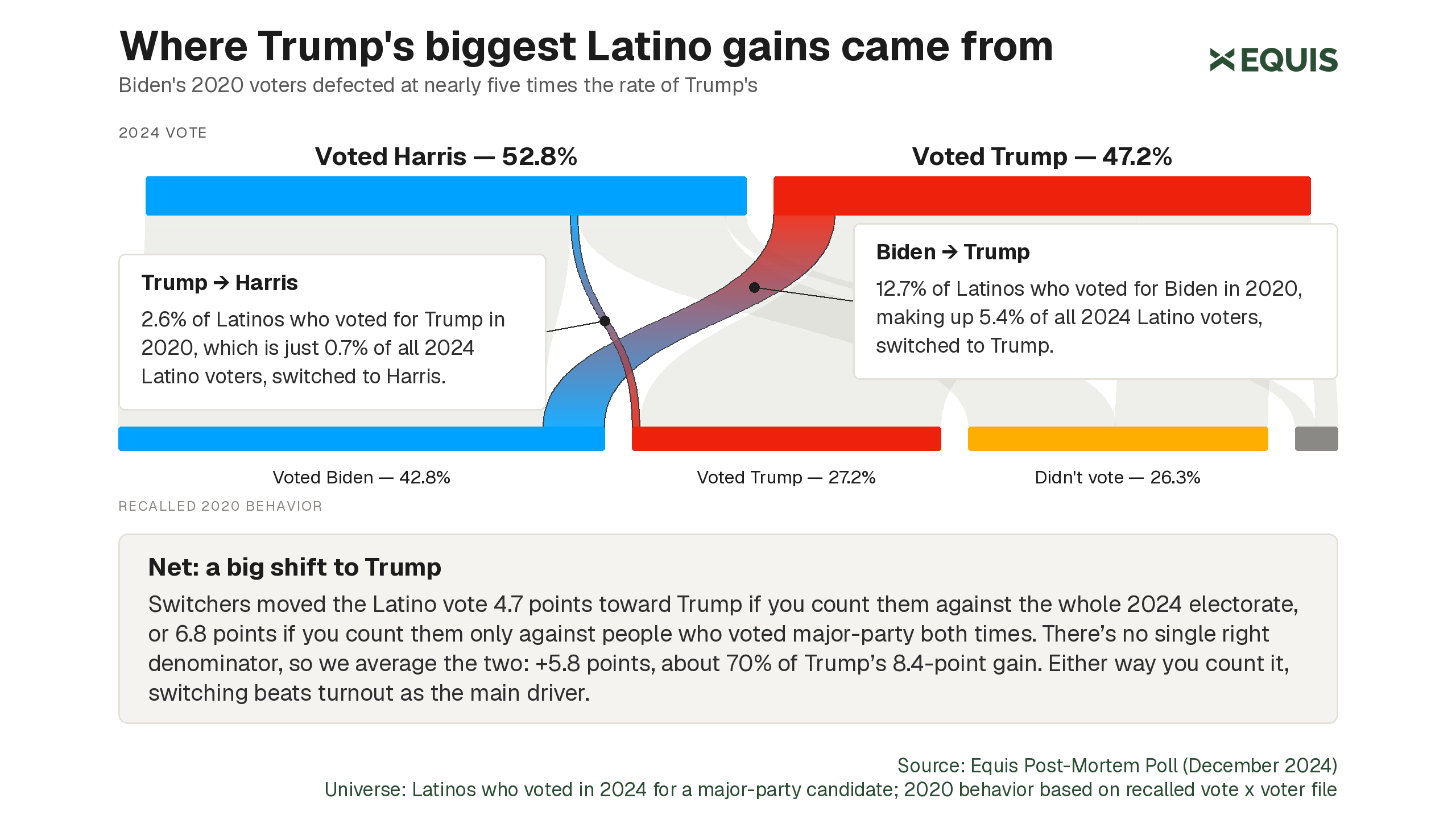
2. Trump also showed surprising strength with irregular voters – to the point that if all Latinos had voted, Trump would have done even better.
It might be tempting to think that if more Latinos – or more of the right Latinos – had voted, that could have canceled out Trump’s gains among the vote switchers. Maybe turnout really was the problem (and the solution) all along. It’s a thought that has deep roots.
An increasingly popular assumption in the Obama years was that the growth and increased participation of the Latino electorate would benefit Democrats.6 A corollary was that if every Latino voted, Democrats would do better. At times, that has been true. The mistake was in assuming it was a permanent feature.
During his first term, Trump began making inroads with irregular Latino voters: those who are eligible to vote but whose participation in elections is infrequent or difficult to predict.7 By the time November 2024 rolled around, his strength was on full display.
Take new voters, those who voted in 2024 but not in 2020. Democrats had been accustomed to winning new voters, including Latinos, since at least 2006, per exit polls and Catalist estimates. In 2024, Trump drew essentially even with Harris among new Latino voters in our post-election polling, wiping out that traditional advantage.
And if all Latinos had turned out? Our evidence suggests that if every Latino had voted, Trump would have made even greater gains.
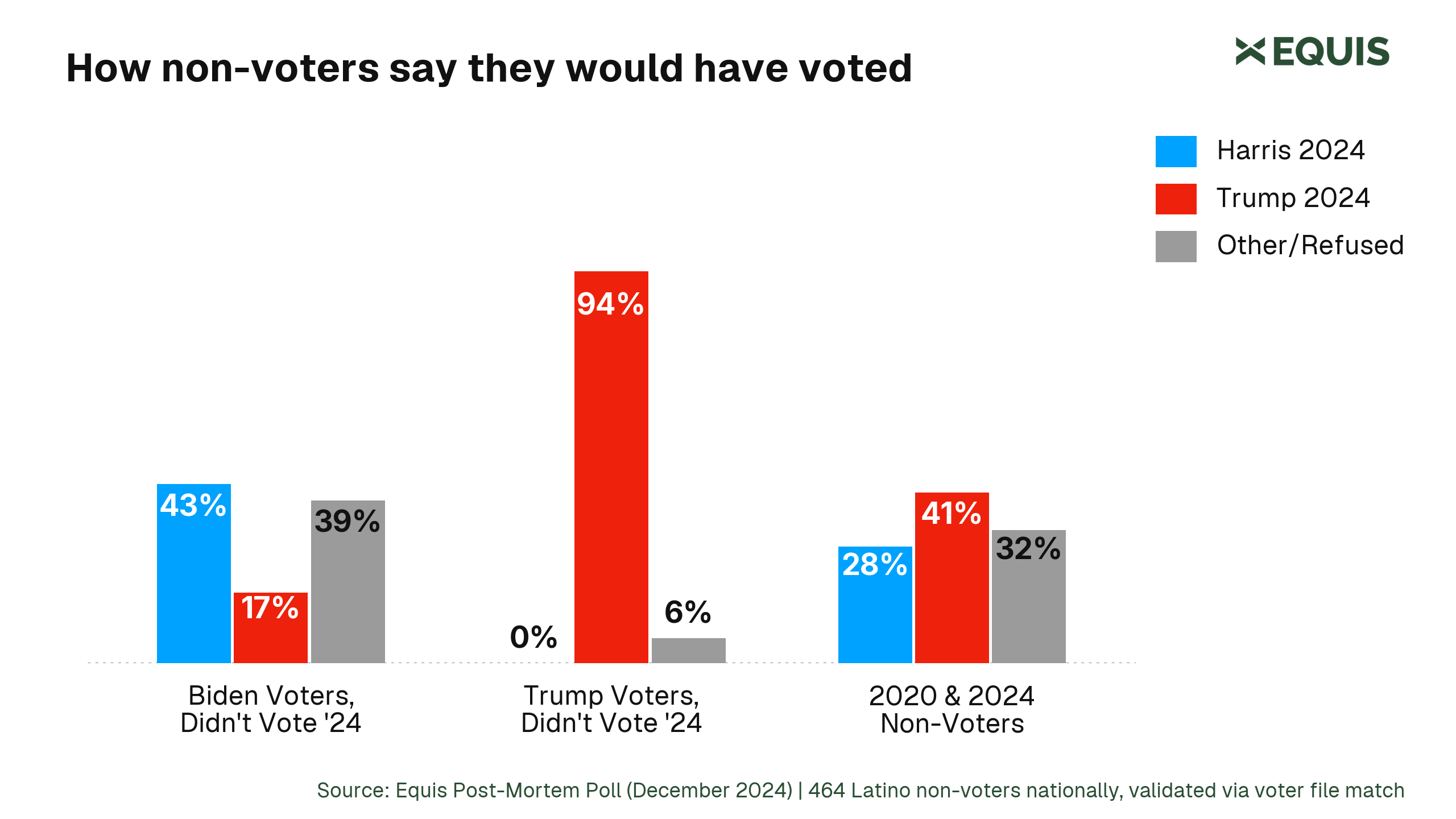
In Equis’ post-election polling, we asked Latino non-voters who they would have supported. Among those who picked one of the two candidates, Trump was preferred over Harris by 12 percentage points.8 (Another 25% either said “someone else” or insisted there was no way they would have voted.) This is a far cry from the image of Latino non-voters as a reservoir of support for Democrats only waiting to be tapped.
3. Mobilization alone wouldn’t have overcome Trump’s edge with Hispanics.
Even if we zoom in on the 2020 Biden voters who stayed home in 2024, there is no realistic scenario in which higher turnout alone would have offset Trump’s gains. Take the most generous assumptions available: every Biden abstainer turning out, every one of them voting for Harris, and Trump’s own abstainers staying home. Even then, Trump’s two-party gains would have only been cut in half.
An implausible assumption at the best of times, and one that appears even more so when we look at what the abstainers themselves told us. Less than half of the Biden abstainers (43%) said they would have voted for Harris. Nearly a fifth of Latino non-voters who’d voted for Biden in 2020 (17%) said they would have voted for Trump in 2024, in the hypothetical. That is a sizable rate of defection. Another 39% of these Biden abstainers insisted they wouldn’t have voted or refused to pick between the candidates. There was no such ambivalence among 2020 Trump voters: virtually all of them said they would have voted for Trump had they turned out.
This is what we mean when we say that the Democrats’ central problem among Latinos has been one of persuasion, even when it has had a turnout dimension. Higher turnout alone – whether we are talking about Biden abstainers or all irregular voters – without any change in preferences, i.e., without persuasion, would not have negated Trump’s gains.
4. Swing and turnout did not operate in separate boxes. At the heart of the Latino vote, and how it changes, is the “Steitz voter,” who looks like a mobilization target but needs to be persuaded.
While persuasion pervades the analysis above, you may have noticed the line between persuasion and turnout can get blurry. That is obvious among new voters and non-voters. What’s less obvious is that there is a turnout dimension even among the vote switchers.
A large share of vote switchers are also irregular voters. What this means is that most wouldn’t qualify as persuasion targets under conventional criteria of campaign targeting. Those criteria pick up those who are likely to vote and less attached to any candidate or party: in the parlance, voters who are high-propensity but middle-support.
Most of the Latinos who swung to Trump wouldn’t make the cut. In fact, between their voting patterns and a presumption of partisanship (nearly half were scored as likely Democrats), only around 12% of the Biden defectors would have ended up in a classic persuasion universe. Segregating support and turnout masks the fact that much of the action among Hispanic voters is happening in the liminal space where the two dynamics overlap.
Imagine that instead of living in separate universes, mobilization and persuasion exist in a multi-dimensional space. Mark Steitz long ago visualized this as a triangle plot, where the likelihood of voting, the likelihood of supporting a Democrat, and the likelihood of supporting a Republican are jointly mapped for every (theoretical) voter.9
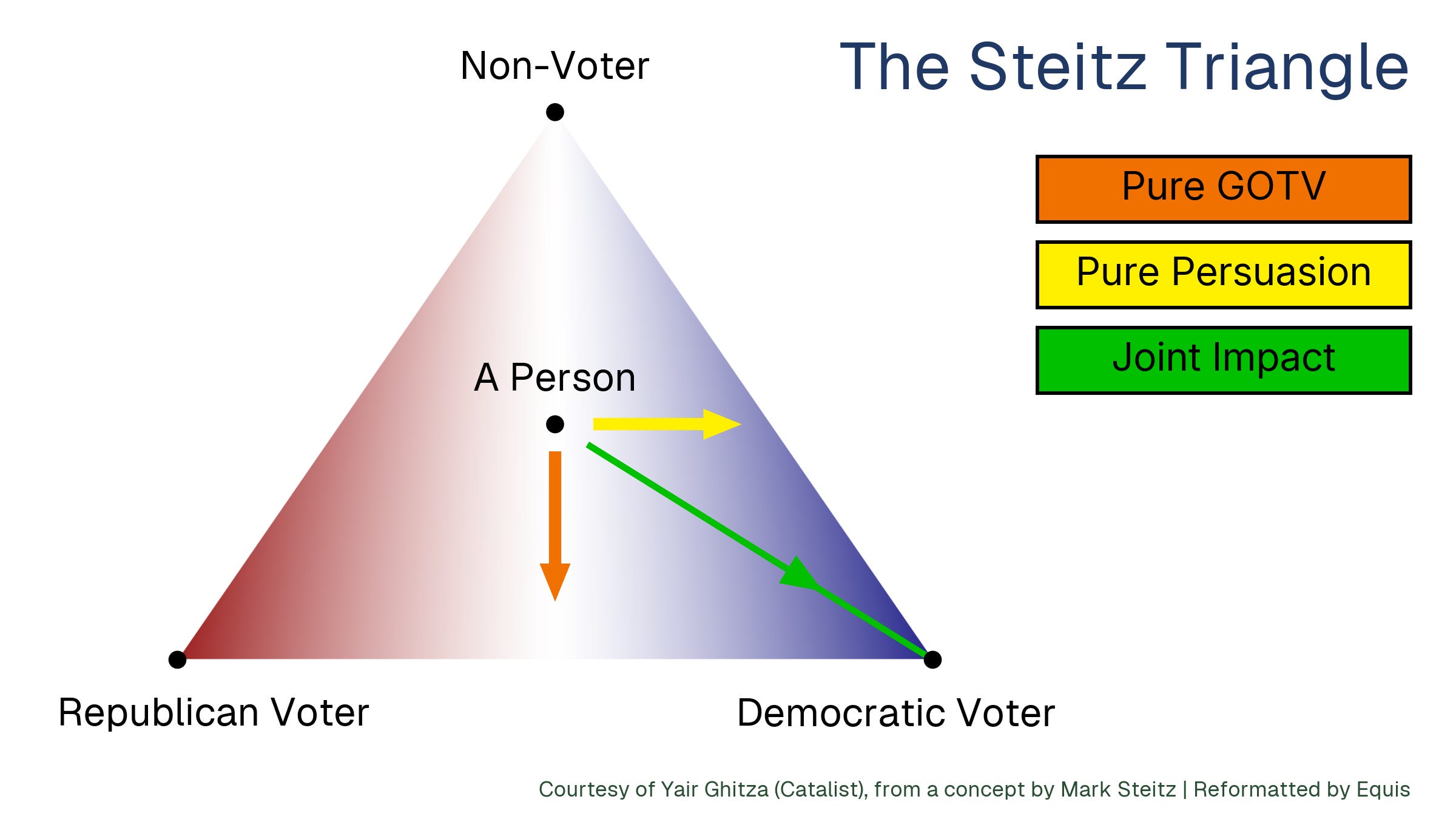
The traditional persuasion and mobilization targets are represented here: those who are set in one behavior but can be influenced in the other. Pure GOTV takes someone who is a solid Democratic (or Republican) voter and moves them along the vertical axis toward increased certainty of voting. Pure persuasion takes someone who is set on voting, and moves them horizontally, toward one partisan camp or the other.
But the center of the triangle is occupied by voters who are both mid-propensity and non-partisan. What makes them less likely to vote – a weaker connection to politics and parties – also makes them more persuadable. The decision of who to vote for and the decision of whether to vote at all can go hand-in-hand. They need both persuasion and mobilization.
The real-world implication of this insight is that irregular voters are some of the swingiest out there – and consequently, their entrance into the electorate, when it happens, carries the potential for significant upheaval.10
This is not a new discovery. A seminal text of political science, The American Voter (1960), observed large shifts in the partisan preferences of non-voters in elections between 1948 and 1956. Its authors found the non-voter to be “less stable in his partisan inclinations than the voter,” and thus “more responsive to the massive political stimuli that produce shifts of popular attitude over time.”
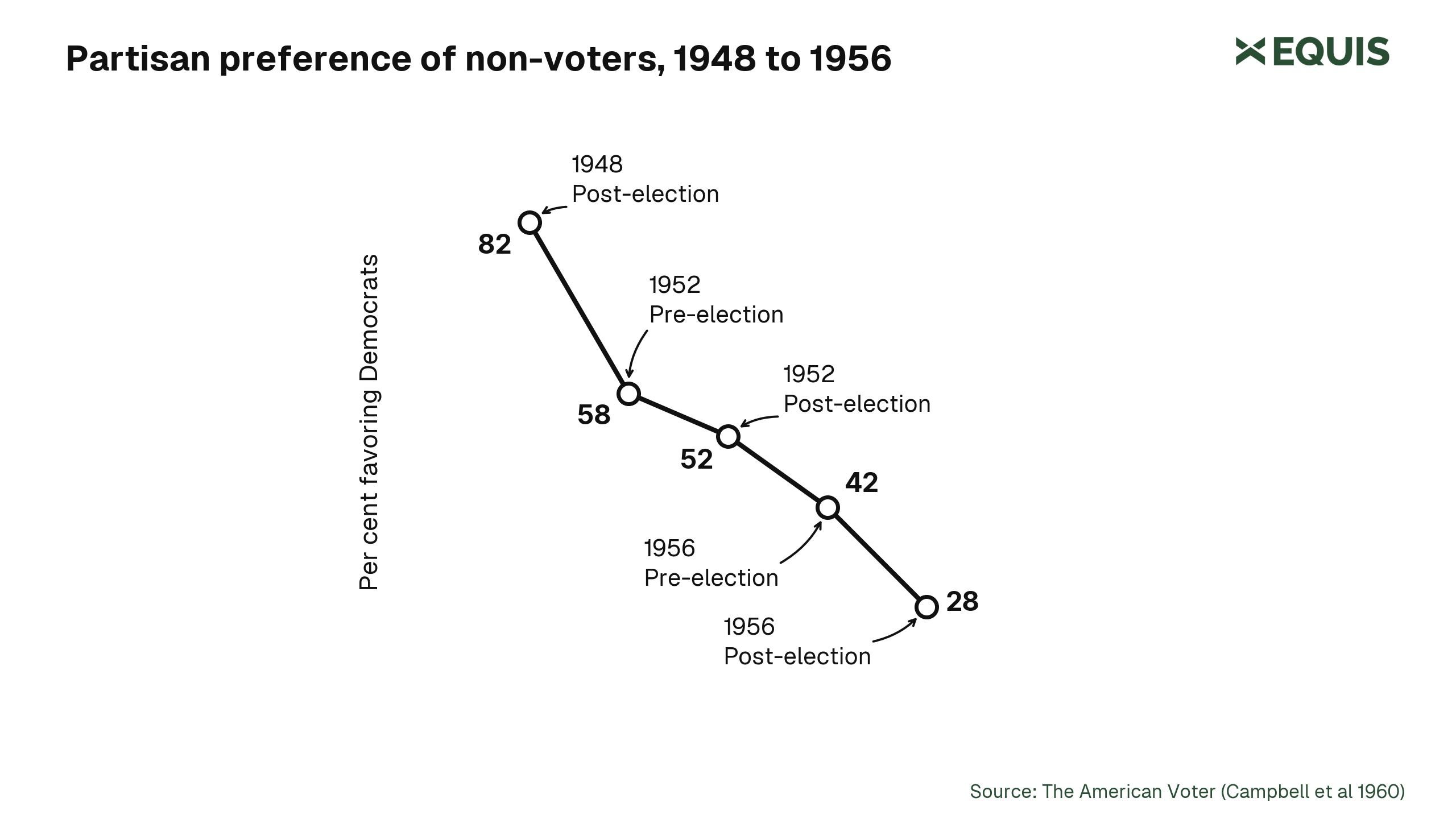
We see the same among Latino non-voters today – who are valuable to study not just for their own sake but for what they reveal about infrequent voters more broadly. Like the Eisenhower non-voters of the 1950s, this group has been on the move. The 2024 non-voters have gone from favoring Trump in December 2024 to favoring congressional Democrats in the 2026 generic ballot by a 2:1 margin.
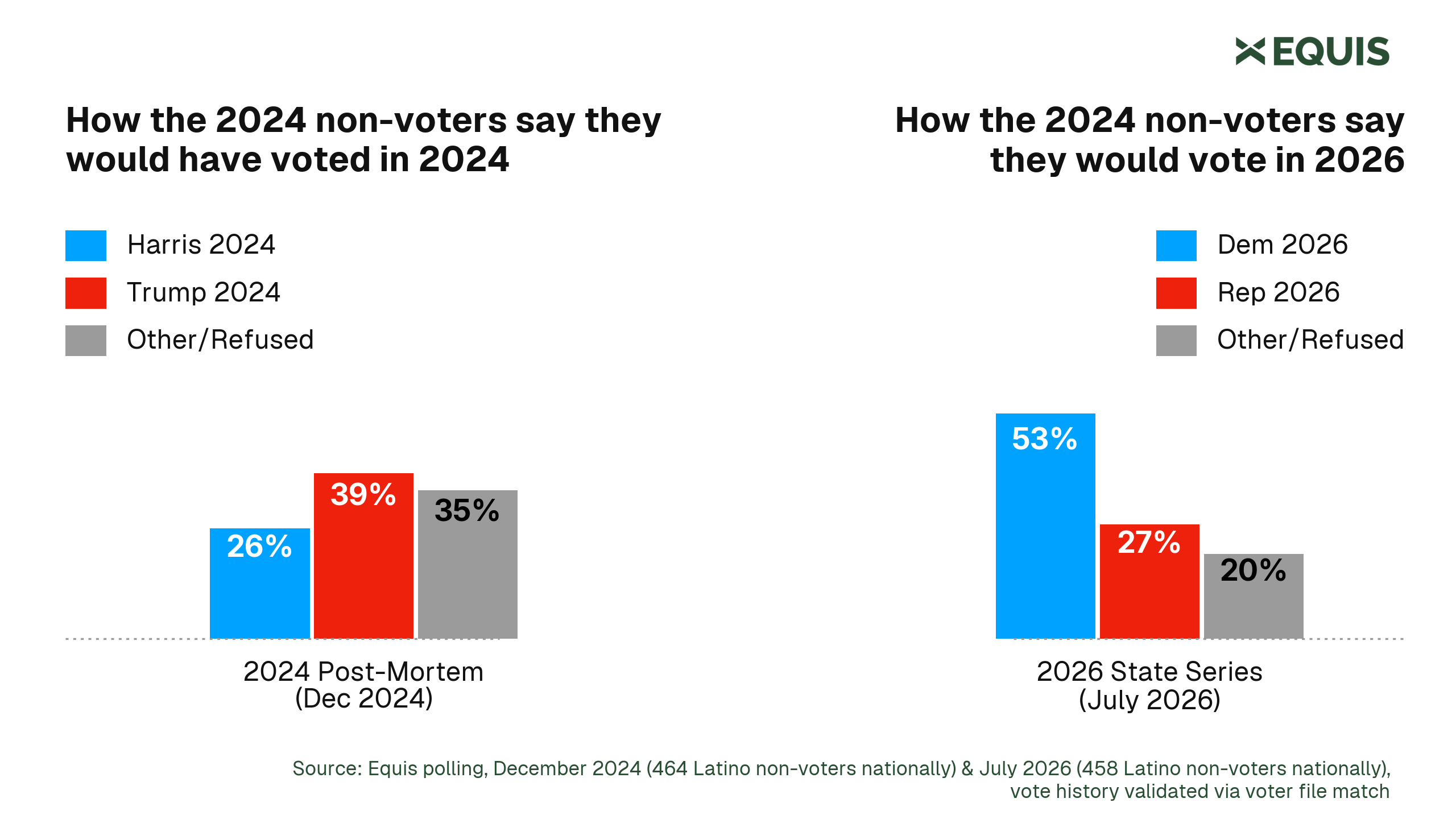
One might be tempted to write off the malleability of infrequent voters. They are, after all, infrequent – many are non-voters. But voting propensities are not a permanent state of being, especially among Latinos.
The Latino electorate today is characterized by a high rate of churn. In any two elections we’re not talking about the same electorate. According to Catalist estimates, 40% of Latinos who voted in 2020 were new presidential voters (compared to 29% of all voters), and in 2024 the figure was 28% (compared to 21% of all voters). It is true, too, in midterms: our educated approximation at Equis is that 12-15% of Latinos who vote in 2026 won’t have voted in 2024 (compared to ~9% for all voters).
Put together churn and malleability and you have a recipe for the kind of swings we’ve seen among Latinos in the Trump elections. Infrequent voters are heavily influenced by “the short-term forces of the election – differential candidate appeal, issues, scandals, and so forth.”11 So the churn can bolster the Democrats in a Democratic moment, but can also catalyze rightward change if the environment shifts in a GOP direction.
5. The implication for campaigns is the need for broad persuasion, even when they also need to mobilize. Persuasion is about more than ads: it is about a mindset that governs the entirety of a campaign’s activities.
In an electorate deeply entrenched and growing more so, swing voters are rare and yet likely to decide elections at every level of the ballot. Shiro Kuriwaki refers to this as the Swing Voter Paradox.12 If the overall electorate is split in a predictable fashion, then the choices of those willing to switch sides are more likely to decide the outcome, no matter how tiny a group they represent.
Big thermostatic swings like the one among non-voters during Trump’s second term are not attributable to tactics, the outreach mechanisms of a campaign. Infrequent voters aren’t turning on Trump because of ads. While campaigns might not generate these reactions, they do capitalize on them, and that is where they prove their worth: in picking up the ball and moving it the last few inches, to win a few more votes than they otherwise would, in contests they’d otherwise lose.
The House map in 2026 is uniquely Latino, relative to the rest of the population. Hispanics represent some 20% of eligible voters in the 36 most competitive House seats, compared to 13% of eligible voters nationally. This appears to us a new phenomenon. And it means that changing the minds of some Hispanic voters will have a greater impact on the congressional seat count than it has before.
Those voters willing to switch sides are to be found outside of the old familiar places. Of the Hispanic voters that Equis identified as 2026 swing voters in a July poll (including the undecided and potential switchers), only 4% would fall into a traditional persuasion universe.
Nothing in this essay negates the need for campaigns to register voters or run GOTV. Quite the opposite: the churn of the Latino electorate increases the stakes of moving the next wave of voters. There are tactical implications to the Steitz framework: the need to win supporters among the softly partisan, infrequent voters – in addition to (or in advance of) mobilization – for example, or to follow up with persuasive communications for new registrants.
But allow us to dwell an extra minute on persuasion, because it is the piece most often misunderstood.
The tactical mechanics of persuasion are known, if hard to execute. Messengers matter in determining whether a voter accepts a message. Issues directly relevant to voters make them pay closer attention. New, specific information can change their voting calculus. Communication can raise the salience of some identities over others. True, the effects of something like ads can be small and short-lived – but they still move people, just enough.13
And yet persuasion does not start with paid communications at the end of a cycle.
Persuasion requires a certain mindset: being oriented toward winning people over, rather than assuming they are already on your side and simply need to be galvanized. A persuasion mindset can be implemented across all the decisions a candidate or party makes, across all the points of contact between elections: the legislative votes cast; the policy positions staked out; the reactions to breaking news; the appearances and interviews, across all available forums, virtual and in-person, where they might conceivably get some attention. These, too, can convey new, relevant information about what the parties and their leaders prioritize and, most importantly, who.
The fact that persuasion still works is, to us, a source of hope. Democracy is premised on persuasion, and the ways of persuasion, which are most forceful when they are particular and emotional and relevant, still stand out against the great impersonal machinery of history as refreshingly human methods of change.
More soon from The New Dynamic.
Have a tough question you’d like us to tackle? Leave a comment or email us at newdynamic@equislabs.us.
Vote switching goes by many names: swing, defection, conversion, etc. We use them interchangeably here. In 2024, what we mean when we talk about vote switching is voters who moved from supporting Biden in 2020 to supporting Trump in 2024, or from Trump in 2020 to Harris in 2024.
This finding is not the artifact of a single post-election poll where winner’s bias could potentially inflate vote switching. Consistently throughout Equis polling in the 2024 cycle, a meaningful share of Biden 2020 voters (ranging from 8-14%) told us, explicitly, that they intended to cross over to vote for Donald Trump.
Math alert. The old campaign adage is that a switched vote is worth two new votes. That is true at parity between the candidates. The math of vote shares is a little more complicated beyond that scenario, because a new voter also expands the electorate, diluting the impact of a new vote in percentage terms. Mathematically, the actual ratio (R) of impact of vote switching to turnout depends on the candidate’s starting vote share (p): R ≈ 1/(1 − p). So if a candidate is at 50%, then a switched vote is worth two new voters to them. But it varies at different levels of starting support. For Trump, starting at 37% among Latinos, vote switching had about 1.6 times the impact of new voters. For a candidate already starting at 60% (which is closer to where Dems have usually been with Hispanics), a switched vote is worth 2.5 times that of a new vote.
Note on the math in the chart: Trump’s gain among Latino voters came from overlapping changes: vote switching, and changes in the electorate (abstainers, new voters). Because both happened at once, the credit assigned to switching depends on whether you measure it before or after accounting for the change in who showed up. Neither order is more correct, so we take the average of the two. The conclusion doesn’t depend on the averaging: under either method, switching accounts for most of the gains.
Not all of them were literal 2020 non-voters: about 1-in-8 (3.8% of all 2024 Latino voters) couldn’t be matched to the voter file, said they voted for another candidate, or refused to answer. They split 52 to 48 for Trump, essentially the same as the other new voters.
The notion that high turnout (among all voters, not just Latinos) systematically advantages Democrats is a longstanding debate in political science. For a debunking of it, see The Turnout Myth: Voting Rates and Partisan Outcomes in American National Elections (2020), from Daron R. Shaw and John R. Petrocik (link). “Demographics as destiny” usually leads to The Emerging Democratic Majority (2002), from John Judis and Ruy Teixeira, but a better example is Teixeira’s 10th anniversary reflection after Obama’s re-election. The argument that turnout always helps Democrats is harder to sustain these days, now that Trump has cemented a base among a traditionally low-propensity voter and Democrats are thriving among a traditionally high-propensity voter (both related to the education divide).
See the first part of our 2020 post-mortem, at https://www.weareequis.us/research/2020postmortem-pt1
There are two data issues here worth acknowledging. One is winner’s bias: non-voters might be more inclined to say they would have voted for Trump because he won the election. The second is deeper: people are not always willing or able to say what they would really do in a hypothetical scenario. Even if one or both issues are present in our data, causing us to overestimate Trump support among 2024 Latino non-voters, we think our broader point still carries. (1) We also saw Trump winning irregular Latinos in our own pre-election polling from May-October 2024, where winner’s bias wouldn’t be present. (2) Even if true Trump support in this group was closer to an even split, that would still represent a significant change from the Democratic margins of the past, calling into question the assumed link between higher Latino turnout and advantage for the Democrats.
Steitz’ simplex triangle is described in Stephen Baker’s The Numerati (2009). The framework is often championed as “wisdom of the ancients” by data guru Jonathan Robinson, who first brought it to our attention.
An intuition of the triangle is that in probabilistic terms, these voters in the middle have the same, or greater, expected value to a campaign than other classic targets. A voter with a 60% probability of voting for a candidate and 60% probability of turning out has a 36% chance of casting a ballot for that candidate. A mobilization target with an 80% support probability and 45% chance of voting has the same expected value. Of course, the two are only equivalent on paper. What a campaign can do with a voter in the middle is move their preference. And, as we know, a moved preference is worth roughly twice a new vote, because it takes one away from the other side rather than simply adding one to your own. The mobilization target offers no comparable leverage: they are already with you, and the only open question is whether they show up.
Shaw and Petrocik (2020)
He writes: “These findings challenge a common characterization of modern American politics as one dominated by rigidly polarized parties and partisans. The picture that emerges instead is one where swing voters are rare but can dramatically decide the party in power, and where no single demographic group is a swing voter.” Kuriwaki, Shiro. (2021). “The Swing Voter Paradox: Electoral Politics in a Nationalized Era.” Harvard University. (link)
On ad effects see, for example, Sides, John, Lynn Vavreck, and Christopher Warshaw. (2022). “The Effect of Television Advertising in United States Elections.” American Political Science Review.
Does stretching a paragraph of common sense intuition into an overwrought and conceited "thinkpiece" make you feel good about yourself?